
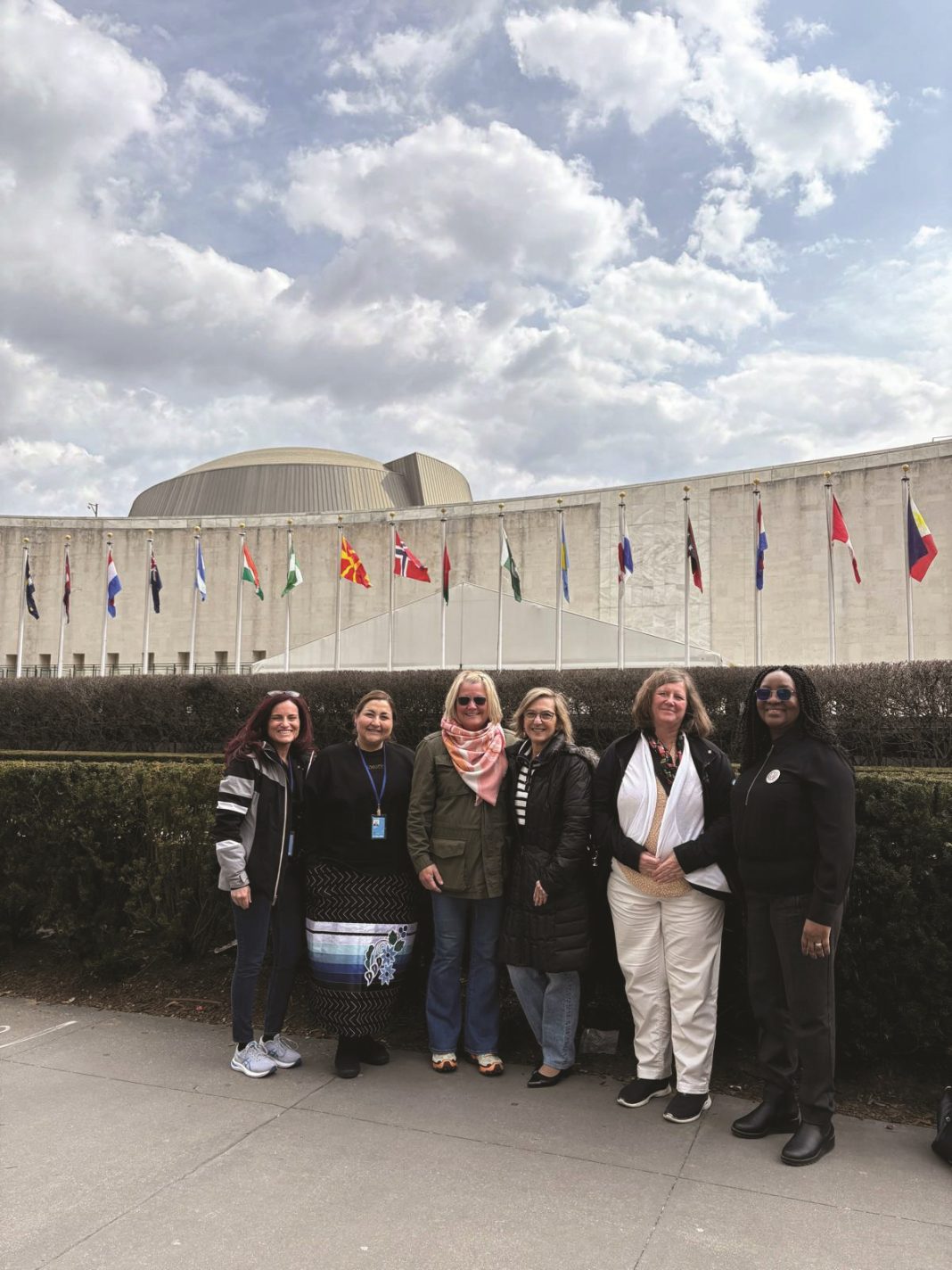
(L-R) Dianna Corazza, former Provincial Executive member; Tesa Fiddler, Diversity Advisory Board member; Melissa Cowan, Status of Women Committee; Mary Lachapelle, Deputy General Secretary; Melissa Garrett, Provincial Executive; and Caroline Chikoore, A.I.D.E. Lead at OECTA Provincial Office
The 69th session of the UN Commission on the Status of Women (CSW69) in New York was a powerful reminder of both the progress made and the challenges that remain in the fight for justice. Held from March 10 to 21, the session reviewed the implementation of the Beijing Platform for Action, a landmark declaration adopted in 1995 to advance gender equality and women’s empowerment globally.
A six-member OECTA delegation arrived on March 10, shortly after our 2025 Annual General Meeting. As I immersed myself in discussions, debates, and presentations, I reflected not just on policies and resolutions, but also on the broader implications for our collective journey toward justice and equity.
Defending Equity in a Time of Backlash
CSW69 was both a beacon of progress and a battleground for justice. Regressive governments and organizations are actively seeking to undermine hard-won gains, challenging the use of the term “gender,” reproductive rights, protections against gender-based violence, and discrimination based on sexual orientation and gender identity. Particularly concerning was the American administration’s rollback on diversity, equity, and inclusion policies and initiatives.
In Canada, the urgency of this fight became clear when Prime Minister Mark Carney eliminated key equity and inclusion roles from the Liberal cabinet, including the Minister for Women and Gender Equality; the Minister of Diversity, Inclusion, and persons with Disabilities; and the Minister of Employment, Workforce Development, and Labour. This decision was a stark reminder that progress is never guaranteed– it must be defended, strengthened, and relentlessly advanced. In response, both the OECTA and Canadian Labour Congress (CLC) delegations swiftly condemned the move, reaffirming their commitment to equity and inclusion.
Key Discussions and Insights
Despite these challenges, CSW69 was a space of resilience, strategy, and forward-thinking dialogue. The most pressing discussions included:
1. Women’s Economic Empowerment
Economic justice was a central theme, emphasizing the need for gender-responsive policies that promote fair wages, decent work, and the elimination of workplace discrimination. Inclusive workplaces were framed not just as a moral imperative but as an economic necessity.
2. Care Work and Social Protection
Care work – often invisible and undervalued– was recognized as fundamental to economic and social well-being. There was strong advocacy for social protection systems that compensate care work and support families, ensuring that economies recognize the true value of caregiving.
3. Intersectionality and Feminist Leadership
CSW69 underscored the importance of intersectional feminism, recognizing that discrimination is compounded by race, gender identity, class, disability, and other factors. Calls for intergenerational leadership and solidarity resonated deeply, reinforcing the need to amplify young feminist voices.
4. The Power of Data for Gender Equality
A “whole-of-society approach” to data collection was emphasized, urging governments, research institutions, businesses, and community organizations to collaborate in gathering gender sensitive data. Without robust and inclusive data, policy implementation risks being ineffective and detached from real-world experiences.
Looking Ahead: Key Takeaways
CSW69 reinforced that while global commitments to gender equality exist, real progress requires tangible action. Key lessons include:
- Gender equality demands continuous advocacy to counter opposition from conservative forces.
- Intersectionality must remain central — one-size-fits-all solutions fail marginalized groups.
- Concrete policies on care work and social protection are crucial for economic justice.
- Technology and artificial intelligence must be leveraged to close equity gaps rather than entrench them.
- CSW itself faces significant challenges, including funding shortages, limited civil society participation, and weak enforcement mechanisms. The CLC is coordinating efforts to revive the UN Commission on the Status of Women through policy recommendations.
Personal Reflections
One of the most inspiring moments for me was the virtual presentation by OECTA’s Sharon Giroux and Tesa Fiddler. Their session, Ontario’s Catholic Educators: Upholding the Rights of Indigenous and Other Equity-Deserving Peoples, was a powerful testament to the role educators play in advancing social justice. Their stories and insights reinforced why this work matters.
Another powerful moment was learning about the advocacy work of disabled women in Africa, who are integrating an intersectional and diversity, equity, and inclusion lens into their activism. Their stories highlighted how these frameworks are essential for advancing women’s rights globally.
Moving Forward with Hope and Determination
Leaving CSW69, I felt both frustration and hope — frustration at the forces seeking to reverse progress but hope in the strength and determination of those fighting for justice. The road ahead is not easy, but itis necessary.
As co-attendee Mary Lachapelle, OECTA Deputy General Secretary, aptly pointed out, “If women succeed, so does everyone else.” That statement underlines the importance of these continued dialogues and the necessity that this work translates to further progress in our locals all around the world.
The most important lesson from CSW69? Gender equality is not just a policy goal; it is a lived reality we must create, protect, and sustain every day.
As I return to my work in accessibility, inclusion, diversity, and equity, I carry with me the voices, experiences, and wisdom shared at CSW69. The fight continues, but so does our unwavering commitment to a just and equitable future.