
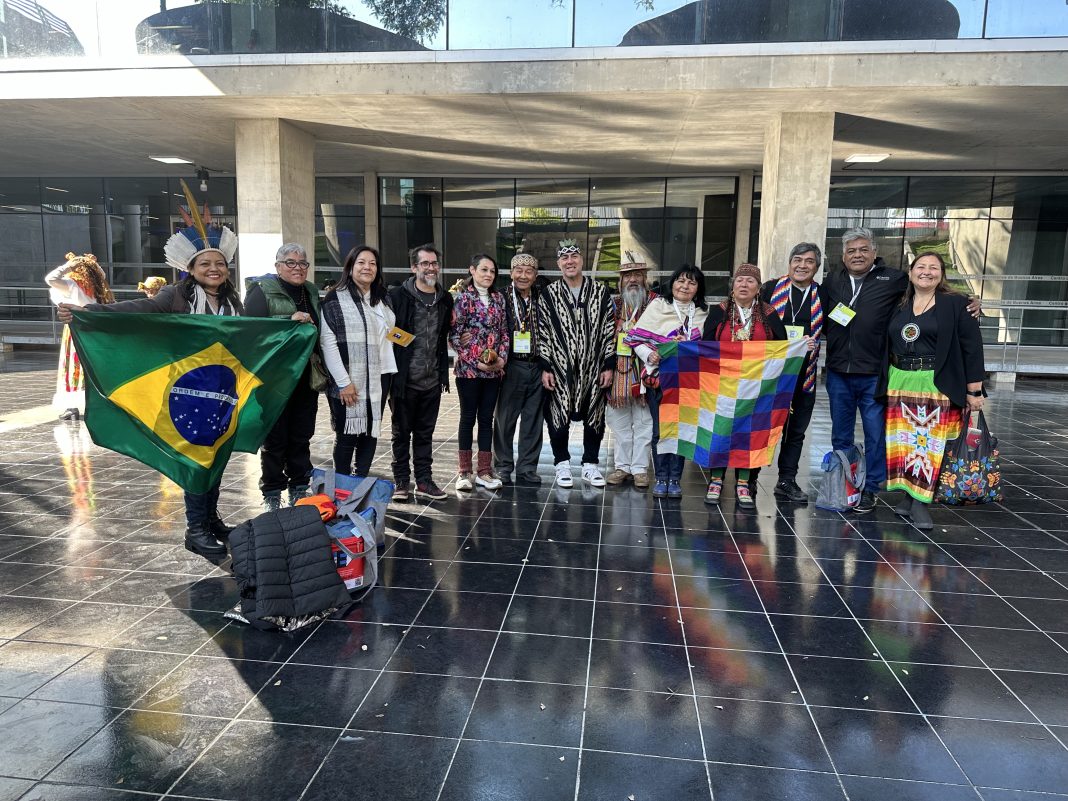
Tesa Fiddler, far right, with members of the Indigenous Peoples Caucus at EI’s 10th World Congress, July 2024.
The Ontario English Catholic Teachers’ Association (OECTA)has demonstrated a commitment to equity, inclusion, and reconciliation through its ongoing work to advance the rights of Indigenous and equity-deserving peoples within education. OECTA’s dedication is evident in structures and roles such as the Diversity Advisory Board (DAB) at the provincial level, the Vice-President of Equity role on the Provincial Executive, and the active network of local unit equity advisors across the province. These initiatives ensure that equity and justice are embedded into every layer of the Association’s advocacy, governance, and day-to-day operations.
The Association’s commitment to Indigenous rights is part of a broader global movement for justice. This was affirmed through the organization’s support of the development and unanimous adoption of Education International’s (EI) resolution “Asserting and Defending Indigenous Peoples’ Rights Within and Through Trade Unionism.” EI, a global federation representing over 32 million educators in more than 170 countries, emphasizes that the fight for Indigenous rights in Ontario’s Catholic schools is connected to a worldwide movement for equity, cultural survival, and self-determination.
A Personal Commitment to Justice
As a First Nations teacher, this resolution holds deep, personal meaning. Bothof my parents are residential school survivors and their experiences, much like those that many other community members have experienced, continue to impact my family and community. These lived experiences fuel my dedication to ensuring Indigenous students have access to education that respects and celebrates their identities, histories, and inherent rights. My commitment is to continue to advocate for Indigenous rights, equity, and inclusion within education through my work as a teacher in Thunder Bay and in my role as a provincial DAB member.
Confronting Injustices
The EI resolution acknowledges the historical and ongoing injustices Indigenous Peoples face globally, including colonization, forced assimilation, and exclusion from decision-making. It affirms rights to self-determination, language, and culture as enshrined in the United Nations Declaration on the Rights of Indigenous Peoples (UNDRIP).
Some of the key commitments of the resolution call on world governments and education systems to:
- Recognize Indigenous Peoples’ inherent rights to control their own education systems.
- Integrate Indigenous languages, histories, and knowledge into public education.
- Support bilingual and immersion programs that strengthen language revitalization.
Challenging Racism and Colonization
EI calls on educators to dismantle systemic racism and challenge colonial narratives. The Association’s work – through its equity frameworks, advisory boards, and commitment to professional learning – has created pathways for members to:
- Embed anti-racism and decolonization in daily practice.
- Challenge Eurocentric biases in curriculum and pedagogy.
- Build meaningful partnerships with Indigenous communities to co-create educational reforms.
The resolution also highlights the importance of recruiting, retaining, and supporting Indigenous educators. School boards and teacher associations need to advocate for fair working conditions, leadership pathways, and culturally safe environments where Indigenous teachers see themselves as equal colleagues.
Global Collaboration
The EI resolution was crafted by the EI Indigenous Reference Group, which is a collective of Indigenous educators from around the world. I was honoured to serve as a member of this group, as one of the representatives of the North American and Caribbean region. I travelled to Buenos Aires as a part of the Canadian Teachers’ Federation delegation to participate in the global assembly and I had the privilege of addressing the assembly, speaking to the urgency of this resolution and what it means for Indigenous students and teachers.
Facilitating the Indigenous Peoples Caucus at the start of the assembly was a highlight of my experience. We engaged in rich dialogue with Indigenous educators from across the globe, listened to union leaders share their advocacy journeys, and were welcomed into the week with a traditional ceremony led by Indigenous Peoples of Argentina. This was a powerful reminder that our ceremonies, beliefs, practices, struggles, and hopes are shared globally.
The Role of Ontario Catholic Teachers
Ontario Catholic teachers are uniquely positioned to put this resolution into action. Grounded in Catholic social teachings that emphasize justice, human dignity, and reconciliation, teachers can: Integrate Indigenous perspectives, histories, and contributions across subjects and grades.
- Create culturally safe, affirming spaces where Indigenous students’ brilliance and excellence can shine.
- Support Indigenous language revitalization.
- Advocate for policies that center Indigenous voices and leadership.
- Engage in professional learning that fosters cultural humility and decolonized practice.
- Advance the Truth and Reconciliation Commission of Canada’s (TRC) Calls to Action, particularly Call to Action #62, which calls for the inclusion of age-appropriate curriculum on residential schools, Treaties, and Indigenous Peoples’ historical and contemporary contributions to Canada.
Why This Work Matters Now
June, National Indigenous History Month in Canada, offers an essential reminder of the resilience and brilliance of First Nations, Inuit, and Métis Peoples. It is also a time to confront the enduring legacies of colonialism and renew our commitment to meaningful reconciliation. Highlighting the EI resolution during this month isa reminder that our work as Catholic teachers is both local and global in scope.
For me, and for many others, National Indigenous History Month is not only a celebration, but a time to deepen our collective efforts to ensure that Indigenous students and teachers feel valued, respected, and empowered in our schools.
A Call to Action
The “Asserting and Defending Indigenous Peoples’ Rights Within and Through Trade Unionism” resolution serves as a global call to action for educators, unions, and governments. It demands long-term commitment and meaningful collaboration with Indigenous Peoples.
It is my hope that teachers across this province will bring reconciliation into their daily teaching. Teach about Indigenous brilliance and joy. Engage with the TRC’s Calls to Action, build relationships with Indigenous communities, and commit to personal lifelong learning and unlearning. The Association is providing the infrastructure, tools, and leadership to support this journey. It is our responsibility as Catholic teachers to ensure we use them to their fullest potential.
Reconciliation is not a one-time lesson or school initiative, it is an ongoing commitment to justice, healing, and transformation. Together, as part of a global movement and a strong local network, we can ensure that publicly funded education becomes a powerful force for truth, justice, and equity.